
News
What 2026 Holds for UK Courier Firms: Opportunities, Headwinds, and a Roadmap for Survival
As the UK’s leading courier insurance broker, our team of courier van insurance specialists keep a close eye on what’s happening in the market. 2025 was another good year for the sector. IBIS World estimates the industry has grown by around 4.4% this year and is now worth £17.4bn. Increased demand from e-commerce is largely behind the boom, and things like parcel lockers have transformed last-mile deliveries.
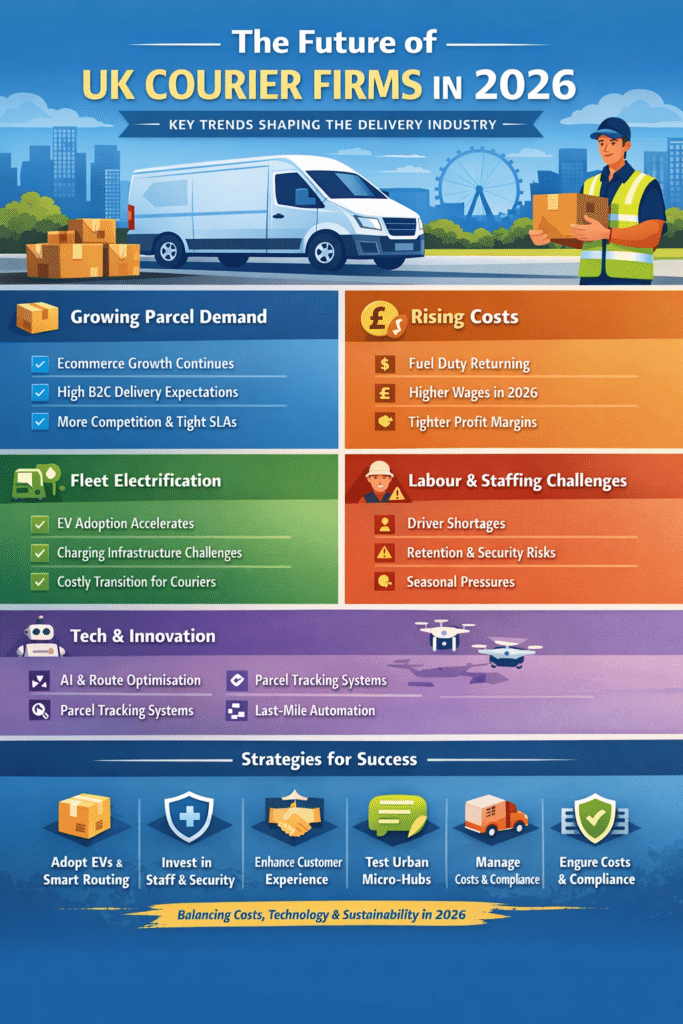
But what does 2026 hold for the UK’s courier firms? Our courier insurance team believe 2026 will prove to be an important year for the sector as:
- Parcel volumes and e-commerce continue to grow
- Costs, especially labour costs, will rise
- Courier insurance quotes will continue to fall
- Operation complexities will increase, as will customers’ expectations
- Automation and AI will be widespread
- Electrification of courier fleets will become more widespread
For courier firms, 2026 will be a year that rewards firms that can balance investment in green fleets and technology with discipline on margins and customer service. In this blog, we’ll look at the trends that will shape the UK’s delivery market in 2026, consider the practical implications for courier firms and suggest strategic actions firms should take to thrive.
We hope this will prove helpful. If you’d like some courier insurance help or a courier insurance quote, then please get in touch. You can call us on 01782 308372 or get a quote here.
Demand Picture: Steady parcel growth, but it’s not uniform
The COVID-19 demand spike and subsequent lull owing to supply chain issues have finally left us. Most industry experts and parcel market reports show that UK parcel volumes and delivery revenue will grow in 2026, with consumer demand being particularly strong. Growth of 3-4% is expected, though that figure may rise if the economy grows and consumer confidence continues to rise.
That’s the good news. The bad news is that customers are demanding more, specifically:
- Faster deliveries – demand for same-day courier deliveries is surging
- Better tracking – people want to know where their parcels are and when they will arrive
- Greener deliveries – ONS research suggests as many as 43% of consumers would pay more for green deliveries
Greater volumes also bring headaches in terms of being able to manage loads at scale. To stay ahead, couriers need to invest in tracking and AI telematics technology and be more flexible. Early morning and later evening deliveries will become more common, and firms that adapt will thrive.
Cost pressures and tax policies: a mixed bag from the Autumn Budget
We looked at what the Autumn Budget means for couriers last month. The key announcements included:
- A phased return of fuel duty increases – the 5p cut was extended to August 2026
- Transition to electric van taxation
- An increase in the minimum wage from April 2026
- The likelihood of pay-per-mile road charging
- Help with transitioning to electric courier fleets
- No increase in insurance premium tax (IPT)
Fuel duty changes post August seem unlikely, as the ending of the 5p cut is a significant change. The national minimum wage rise to £12.71 from £12.21 will help drivers but hit courier firm owners. Demand for drivers is at an all-time high, and that has prompted wage inflation. Firms need to look at their cost base and see if they can save money by getting things like cheap courier insurance, reducing vehicle downtime, and optimising routes. With the market becoming ever more competitive, it’s time to cut costs wherever possible.
Electrification: inevitable - but uneven and capital-intensive
We’ve talked about electric courier fleets and whether electric vans are a viable option for couriers. Electric van registrations soared in 2025. The DVSA expects there to be just under 30,000 EVs vans registered in 2025, a 9.4% increase on 2024. Increased numbers of public chargers, lower costs of installing chargers at depots and hubs, tax incentives, and consumer demand are making the transition easier. The problem for many courier firms is cost. Electric vans remain significantly more expensive. A Vauxhall Vivaro-E costs £5,000 more than the diesel version. Public charging costs are also high, and coverage is patchy.
The government is committed to EV and tax sticks, and incentive carrots will doubtless appear in the Spring Statement and the Autumn Budget. For small courier firm,s 2026 is a year to start the transition. They’ll need to use flexible financial models – leasing, charging-as-a-service, shared depots – and do it gradually, van-by-van. Larger firms can amortise infrastructure investments but must manage transition logistics to avoid service disruption.
The government’s broader transport policy (and local Low-Emission Zones in cities) will push couriers towards zero-emission operations in urban centres. Compliance will require not only courier fleet changes but also rigorous emissions standards and supplier management. Customers will increasingly demand carbon reporting and emissions reductions across the delivery chain.
Labour and operational stress: hiring, retention, and integrity risks
The courier industry is labour-intensive. While trials of driverless vehicles are set to take place in London next year, any sort of driverless courier revolution is a way off. In September, the Transport and Logistics Federation (TLF) revealed the Uk needed 76,000 more drivers, and gaining and retaining warehouse staff remains a challenge. In 2026, firms will need to find ways to reward staff, be it through higher wages, shorter hours, less time pressure, or training. It’s a lot to ask in a tough market, but there may not be any choice.
Customer expectations: visibility, speed, and sustainability
2026 will see customers’ expectations of delivery firms reach new heights. Couriers will be expected to:
- Offer (near) real-time tracking
- Offer customers the choice of narrow delivery times, eventually down to hour slots as the major supermarkets do
- Flexible re-delivery options such as divert to work, early and late delivery times, and same-day deliveries
- Carbon-aware delivery choices – 2026 will see the emergence of a trend to allow customers to pay a premium for green (electric vehicle) deliveries, carbon-offset, and quieter deliveries for early and late slots
Courier firms can expect their customers, especially retailers, to offer more flexible service level agreements (SLAs) and greater tracking data. AI will facilitate this, and larger delivery firms are already equipping themselves to gain a strategic advantage. For smaller firms, IT investments in parcel tracking, route optimisation, customer communications, and returns management will be required.
(Even greater) technology adoption: AI, last-mile automation, and micro-hubs
In 2026, AI and automation in the courier market will move from experimentation to deployment. Specific changes will include:
- Machine learning powering route optimisation
- Dynamic driver allocation
- AI-driven demand forecasting based on historic and live data
- Robotics and autonomous last-metre solutions (lockers, cargo e-bikes, drones) will become more common in urban areas
- Driverless courier trials will start
- Micro-fulfilment and urban micro-hub strategies will become more common as firms look to compress last-mile distances
In 2026, we can expect faster, more flexible courier services with formerly expensive/uneconomical services, e.g. rural routes, made profitable. Small courier firms should invest in AI routing platforms as these will offer immediate returns on investment. Drone and driverless technology will see huge investment from the major players. The results of these will make the technology affordable to all in time.
Fragmentation and consolidation: winners and losers
The UK courier market is already dominated by the big five firms. A 2025 report from Shiply revealed that Royal Mail, Evri, DPD, Amazon Logistics, and DHL controlled 87% of the market. In a fight for market share, greater consolidation and acquisition are inevitable. That said, local, last-mile, hyper-local, and SME service specialists could thrive. In the last couple of years, we’ve seen requests for courier insurance from specialist operators soar. Refrigerated, same-day local deliveries, and ones requiring specialist goods in transit insurance have all continued to grow as the major players shun this type of work.
Couriers: an operational playbook for 2026
2026 will be another year of change and challenge. Demand will boom, but so will service expectations. To meet these challenges, courier firms should:
- Create a staged fleet electrification plan – do an assessment of route profiles, charging needs, and leasing options. Use mixed fleets (EVs where suitable and hybrid for long/ rural routes) while planning for full electrification in areas with low-emission zones
- Invest in dispatch and routing AI – the greatest cost reductions come from optimisation — better routes, fewer empty miles, smarter pick patterns. Prioritise tools that integrate real-time traffic and battery state-of-charge for EVs
- Formalise workforce stability programmes – raise retention through predictable hours, clearer career paths, targeted bonuses for peak periods, and investment in driver wellbeing and training. These reduce churn and lower incident risks, so reducing courier insurance costs
- Improve customer experience – better tracking, preferred delivery slots, and easy returns channels — these are key decision factors for retailers and their customers
- Pilot urban micro-hubs and non-vehicle delivery – use dark stores (unused retail outlets that are used as collection points), lockers, cargo bikes, and consolidation points to cut last-mile costs, improve speed, and reduce emissions
What small couriers should do now
For small and independent couriers, the strategy is practical and pragmatic:
- Focus on local reliability and niche customer service.
- Buy (or lease) one or two EVs for urban routes to demonstrate green credentials and reduce city operating costs.
- Use outsourced tech platforms for tracking and routing rather than building expensive in-house systems.
- Form cooperative arrangements with other local couriers for micro-hub use and shared charging.
A Tightening of Emissions Restrictions
Successive Chancellors have looked to reduce vehicle emissions, and more changes are likely to come, including:
- Higher duty for older, more polluting vans, so those with over 75 g/km of CO2
- Potentially higher VED for zero emission vans
- Road charging trials
- More details on carbon budgets
While some of these measures could prove costly/inconvenient, they are necessary. The government has a legal requirement to reduce the UK’s emissions and, as we have said, the existing VED system needs reforming. The market is also demanding greener deliveries. A 2024 Royal Mail survey found that 23% to 27% of UK consumers are willing to pay more for green deliveries.
Closing: 2026 is about delivery excellence — not just moving parcels
2026 will be less about raw parcel growth and more about how parcels are moved. Firms that combine disciplined cost management with smart investment — in electrified fleets where it makes sense, in routing and orchestration tech, and in workforce stability and security — will capture the growth of e-commerce while protecting margins. The winners will be those who view 2026 as a year to professionalise operations, strengthen customer experience, and decarbonise thoughtfully.
What 2026 holds for UK courier firms
Change and challenge. Demand and greater demands. Automation and optimisation. These are the key trends of 2026 for the UK’s delivery firms. Firms that embrace change, specialise and invest will thrive. Those who fail to act will be left by the roadside. It’s set to be another exciting year, one that will lead to a leaner, greener delivery industry.
Like some more van courier insurance help?
If you’d like some personalised help or a courier insurance quote, then please get in touch. You can call us on 01782 308372 or contact us, and we’ll get back to you as soon as possible.
About The Author
Stephen Ashmore is the Managing Director of JMG Sandbach and a courier insurance specialist with over 25 years of industry experience.